Insights
The House Always Knows

5 min read
The numbers moved first.
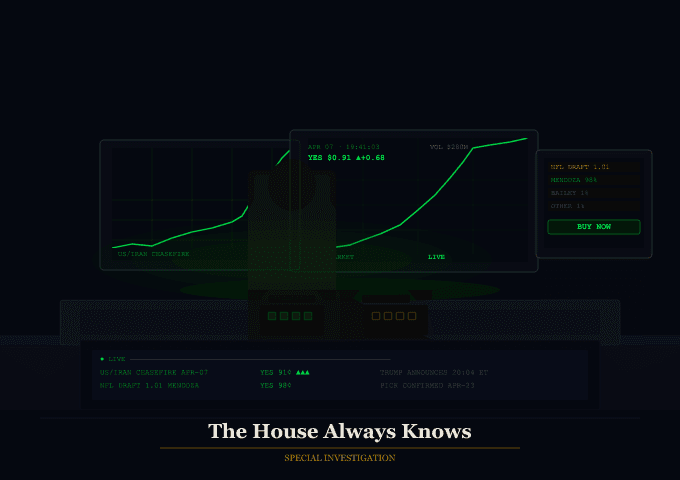
On the evening of April 7, 2026, President Trump was still publicly threatening Iran on social media. His post warned that "a whole civilization will die tonight" if Tehran didn't comply with his demand to open the Strait of Hormuz by an 8 pm Eastern deadline. The rhetoric was as hot as it had been since the U.S. launched airstrikes on Iranian soil in February. Nothing in the public record suggested a ceasefire was coming — and then, hours before Trump announced one on Truth Social, the prediction markets already knew.
At least 50 brand new accounts on Polymarket — some placing their first and only trades ever — had piled large, specific bets on a U.S.-Iran ceasefire happening on exactly April 7. They weren't spreading their bets across a range of dates, hedging against uncertainty like ordinary gamblers would. They were betting on a precise date with the confidence of people who already had the answer. When Trump's post went live confirming the ceasefire, those accounts collectively cashed out hundreds of thousands of dollars in profit.
It looked a lot like someone already knew.
The Promise and the Problem
Prediction markets are a pretty simple concept with a surprisingly powerful pitch. Platforms like Polymarket and Kalshi let you bet real money on the outcomes of future events — elections, geopolitical crises, economic data, and increasingly, minute-by-minute stuff like NFL Draft picks and award-show performances. Proponents call them the most efficient forecasting tools ever built. The theory is elegant: when people put actual money on outcomes, they stop guessing and start thinking hard, and the collective intelligence of thousands of bettors eventually converges on something close to the truth.
That theory only works if everyone is playing with the same information.
What happens when they aren't?
The recent evidence that's piled up around Polymarket and Kalshi suggests these platforms may function less like neutral forecasting tools and more like a quiet mechanism for well-connected insiders to profit from information the rest of us don't have. The pattern is too consistent, too precise, and too politically entangled to wave away as coincidence. And sitting at the center of that political entanglement is one name that keeps coming up: Donald Trump Jr.
The Iran War: A Market That Knew Too Much
The U.S.-Iran conflict that kicked off in February 2026 — airstrikes on Iranian nuclear sites, a naval blockade of the Strait of Hormuz, Iranian retaliation — generated over $2 billion in Polymarket bets in its first four months alone, according to an NBC News analysis. With that kind of money at stake, the question of who knew what and when suddenly carries a lot more weight than it would in a sports prop bet.
The ceasefire trades on April 7 were the most glaring example, but they weren't the only one. In the hours before the U.S. launched the initial strikes in February, at least one anonymous account made roughly $550,000 in a series of trades effectively betting on the attack before it was announced. Researchers at Harvard released a paper estimating that $143 million in profits had been made on Polymarket by individuals who potentially had insider information — not just on the Iran war, but on a wide range of events including the ceasefire announcements and other major geopolitical developments.
In conventional finance, this is called insider trading, and it's a federal crime. If you trade stocks ahead of a merger announcement that hasn't been made public, the SEC will come looking for you. Prediction markets exist in a regulatory gray zone that neither the SEC nor the CFTC has fully claimed. The exact same trade that would trigger a federal investigation on the New York Stock Exchange can be placed freely on Polymarket with essentially no legal consequences.
Republican Congressman Blake Moore, who has introduced legislation to regulate prediction markets, put it bluntly after the ceasefire trades came to light: "It is highly unlikely that these are good-faith trades. It is much more likely that these are insiders with access to information ahead of the public." Democratic Senator Richard Blumenthal went further, writing to Polymarket directly and accusing the platform of becoming "an illicit market to sell and exploit national security secrets unlike any in history."
The NFL Draft: Minutes, Not Hours
The geopolitical examples are striking, but you could argue there's enough noise in global diplomacy for a lucky bettor to occasionally get it right. The 2026 NFL Draft anomalies are a lot harder to explain away.
Polymarket and Kalshi both hosted markets on this year's Draft picks, with significant trading volume across Draft-related contracts. In theory, pick decisions are among the most tightly guarded secrets in professional sports. Teams spend months evaluating prospects, and the final call on any selection is known to only a handful of executives and coaches. Leaks happen — sports reporters cultivate sources — but the kind of precision that appeared in the trading data goes well beyond what circulates in sports media.
In the lead-up to picks being announced, large positions shifted dramatically on specific player-pick combinations, and they did so in the same narrow windows that would be impossible to explain through public reporting. The picks hadn't been televised yet. The players hadn't been called to the stage. But the markets had already moved. 16 draft picks, 16 correct predictions, sometimes made before even the PRIOR pick was announced. 16 for 16.
There's really only one explanation for that kind of timing. Someone with direct knowledge of what the team was about to do placed a bet. This isn't the wisdom of crowds. It's not sophisticated modeling. It's a phone call from inside the building turned into money.
The Man Who Ran Onto the Field. Twice.
If the Iran and Draft examples leave any room for alternative interpretations, the story of Alex Gonzalez does not.
During Super Bowl LX in February 2026 at Levi's Stadium in Santa Clara, a man ran onto the field. It wasn't his first time. Gonzalez had done the exact same thing at Super Bowl LVIII in Las Vegas in 2024, and he appears to have treated both stunts as business decisions. Both times, bets had been placed on prediction markets for a "fan on the field" during the game. Both times, those bets were well-positioned to cash out. Reports estimated that Gonzalez's 2026 stunt may have yielded around $90,000 — with roughly $30,000 bet at +300 odds on a market he was personally going to ensure resolved in his favor.
He manufactured the outcome, then cashed in on it.
The platforms' response was muted. The legal consequences were minimal. The story got some coverage in sports and gambling media, but it never triggered the kind of regulatory scrutiny it deserved — because what Gonzalez did, stripped of the absurdity, was expose the core vulnerability of the entire prediction market model in the most cartoonish way possible. When the person with the best information about an event's outcome is also betting on that event, the "wisdom of crowds" is a fiction. It's just one person cheating.
As one analyst put it bluntly: "Prediction markets should be about probability. They should test how well people can predict the future. But when the bettor is the one jumping the stadium fence, it no longer becomes a game of probability or prediction."
Gonzalez's stunt was brazen to the point of being almost self-parodying. But the underlying mechanic — using information nobody else has to take money from people who don't know what you know — is, critics argue, exactly what more sophisticated actors pull off every time ceasefire odds move before a presidential Truth Social post, or a Draft pick surges before the commissioner reads the name off a card.
The Trump Connection
Any serious look at what's happening here eventually leads to the same question: who has the access, and who benefits?
Donald Trump Jr. is an advisor to both Polymarket and Kalshi. Both companies have said so publicly and leaned into the association as a sign of their political reach. On its face, an advisory role from a high-profile political figure isn't automatically suspicious. Lots of companies hire well-connected people to open doors. But in the context of platforms whose accuracy seems to consistently outpace what public information should allow — and at a moment when Congress and the press are actively connecting prediction market winners to the inner circles of the current administration — the arrangement takes on a very different character.
Trump Jr. is not some retired politician who has gone into quiet consulting. He is an active political operative with direct, ongoing ties to the upper reaches of the U.S. government. His father is the sitting President. The diplomats brokering the Iran ceasefire — Steve Witkoff, Jared Kushner — are family and political allies. His personal and professional network runs through intelligence officials, military advisors, and political operatives who would have early, non-public knowledge of exactly the kinds of events that prediction markets keep somehow pricing in before anyone else does.
The advisory structure itself provides useful cover. Trump Jr. doesn't need to place trades himself. He doesn't even need to directly hand information to traders. An advisory relationship with a platform creates plenty of indirect pathways — employees who trade on what they hear in meetings, large institutional accounts that get more access, well-connected friends who know which markets to enter when a call comes in from the right person.
The bigger picture looks like a deliberate strategy. By tethering these platforms to political power at the very top, Trump Jr. appears to be guaranteeing a steady supply of insider-accurate predictions — which makes the platforms look incredible, which attracts more users and more money, which makes the advisory relationship more valuable. The insider information isn't a side effect of the business. It may be the engine of it.
The Regulatory Void
All of this is made possible — and largely legal — by the almost complete absence of meaningful oversight.
The Commodity Futures Trading Commission (CFTC) is technically the relevant regulator, and earlier this year its new chair announced a sharp reversal from the Biden era: the agency is moving away from proposed rules that would have restricted political and sports-related contracts. That decision — which cleared the runway for prediction markets to operate more freely ahead of Super Bowl LX — came at exactly the moment these same platforms were generating hundreds of millions of dollars in bets on a war being conducted by the administration that appointed that CFTC chair.
The SEC's insider trading rules apply to securities, and prediction market contracts, structured the right way, aren't securities. The result is a gap in the law big enough to drive a truck through: the same behavior that would land you in federal court if you did it on the stock market is, at worst, a Terms of Service issue on these platforms.
There are at least two bipartisan bills currently pending in Congress — one in the House, one in the Senate — that would broaden the legal definition of insider trading to cover prediction markets. Even Polymarket and Kalshi have admitted, when pressed, that they see some need to address the issue. But neither platform has built the kind of trading surveillance that would flag suspicious patterns before a major event. Neither publishes transparency reports on large account activity. Neither has invited an independent audit to determine whether their accuracy comes from genuine crowd wisdom or from people who already knew the ending.
What the Evidence Suggests
To be fair: no single incident here is a smoking gun. Each anomaly, taken alone, has an innocent explanation you can reach for. Prediction markets move on rumor. Talented analysts sometimes get things right. Draft picks leak through legitimate reporting. Ceasefire diplomacy sends signals that sharp observers can occasionally read correctly.
But the pattern — consistent, cross-domain, politically networked, and growing more visible by the week — is something that individual explanations can't cover. It keeps happening, across too many different types of events, with too much precision, on platforms with too convenient a connection to people with access to exactly the kind of information that keeps moving the odds in the right direction before the rest of the world catches up.
Rep. Ritchie Torres asked the right question when he demanded the CFTC investigate the ceasefire trades: "What is the statistical likelihood of anyone other than an insider trader placing a winning bet 12 minutes before a market-moving presidential announcement?" His answer was darkly funny and probably correct: "There are two answers: God, or an insider trader. And something tells me that God is not placing bets around Donald Trump's posts on Truth Social."
Prediction markets were sold as a democratizing force — a place where ordinary people could put their knowledge to work and compete on equal footing. What the evidence increasingly suggests is that they may be functioning, at least partly, as the opposite: a system where those with the best political connections use non-public information to extract money from everyone who showed up to play fair.
The house, it turns out, doesn't just set the odds. The house, in some cases, may already know how the game ends.
This story draws on reporting from NBC News, NPR, the Associated Press, Euronews, and publicly available trading data from Polymarket and Kalshi. It represents an analysis of patterns in publicly observable market behavior.