Insights
The SpaceX IPO - Check Your Portfolio!


0 min read
SpaceX officially will begin trading on the Nasdaq on June 12, 2026 under the ticker SPCX, raising $75 billion at a valuation of approximately $1.75 trillion — making it the largest IPO in history, surpassing Saudi Aramco's 2019 offering. It enters the public markets larger than all but a handful of the world's biggest corporations.
You might assume that unless you are buying shares in the IPO directly, SpaceX has nothing to do with your portfolio — at least not yet. Here's the thing: if you hold any broad-market index funds or ETFs, you may already be on the verge of owning SpaceX without lifting a finger. Index providers have been quietly rewriting their rulebooks, and the result is that tens of billions of dollars in passive fund money is being automatically directed into SpaceX shares in the weeks and months ahead.
Let's walk through the major index funds, what it takes to get in, and what it means for your money.
Why This IPO Is Different
Normally, a newly public company has to prove itself before the major indexes will touch it. The S&P 500, for example, traditionally required 12 months of trading history and four consecutive quarters of positive earnings. That meant most IPOs — even big ones — spent a year or more on the sidelines before passive funds were obligated to buy them. For example, it took Tesla over ten years after their IPO to meet the requirements to be included in the S&P 500.
SpaceX is not a normal IPO. At $1.75 trillion, it immediately ranks among the ten most valuable publicly traded companies in the world. Index providers recognized that keeping a company this large out of their benchmarks would make those benchmarks increasingly unrepresentative of the actual U.S. stock market. The result? A wave of rule changes — some finalized just weeks before the IPO — designed to open the gates faster than ever before.
There is one important catch, however: SpaceX is raising only $75 billion in the IPO, which represents roughly 4% of its total market cap. The vast majority of shares remain locked up — held by insiders, Elon Musk, and early investors who cannot sell for months. This low "float" means the weight SpaceX gets in any index will be much smaller than its total valuation would suggest, at least initially. As lockup periods expire over the next 12–18 months, that weight will grow.
Major Index Funds: Rules, Timing, and Your Exposure
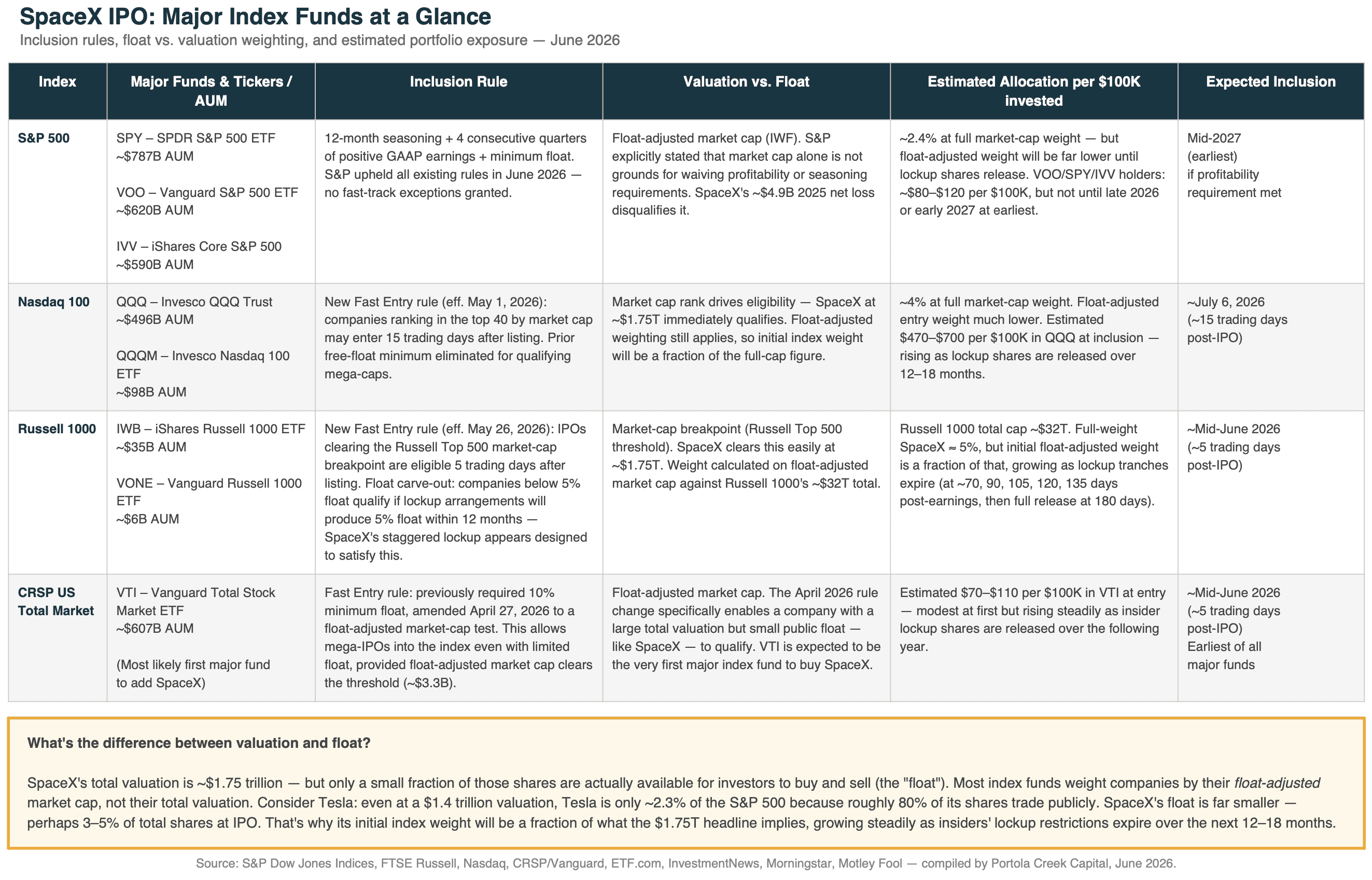
The table below summarizes the largest index funds by provider, their inclusion requirements, whether SpaceX's valuation or its public float drives the weighting calculation, and what a typical investor can expect in terms of portfolio exposure.
What Does This Mean for Your Portfolio?
The short answer: if you hold broad-market ETFs or index mutual funds — in a 401(k), an IRA, or a taxable brokerage account — SpaceX is probably heading your way, whether you intended to own it or not.
Analysts estimate that index fund managers will be forced to purchase between $15 billion and $30 billion in SpaceX shares across S&P 500, Nasdaq 100, and Russell 1000 trackers in the months following inclusion — with more aggressive scenarios well above that figure as the float expands. This is mechanical, rules-based buying: fund managers don't get to decide if they like the price. On rebalance day, they have to buy.
For investors holding growth-oriented funds, the divergence is even more striking. Two growth funds in the same portfolio — say, one tracking Nasdaq 100 Growth and another tracking S&P 500 Growth — could end up a year apart in when they first see SpaceX, simply because their underlying indexes are moving on different schedules.
It's worth noting that one company — SpaceX — losing $4.9 billion last year will soon make up a meaningful slice of funds that millions of Americans rely on for retirement. That doesn't make it a bad investment, but it does mean it's worth understanding what you own and why.
What Should You Do?
We recommend taking a few minutes to review your index fund holdings — particularly broad-market ETFs and total-market funds. If you hold VTI, QQQ, IWB, or any Russell 1000 or Nasdaq 100 tracker, SpaceX exposure is already incoming or imminent. S&P 500 funds (SPY, VOO, IVV) will follow, likely in late 2026 or early 2027 once SpaceX meets the profitability requirement.
As always, we're here to help you think through what this means for your specific situation — whether that's reviewing concentration risk, discussing how this fits with your overall allocation, or simply answering questions about how all of this works. Don't hesitate to reach out.
DISCLAIMER: This article is for informational purposes only and does not constitute a solicitation or recommendation to buy or sell SpaceX (SPCX) or any other security. Portola Creek Capital owns shares of SpaceX and participated in the SpaceX IPO. This material reflects information available as of the publication date; market conditions and index rules are subject to change. Past performance is not indicative of future results. Please consult your financial advisor before making investment decisions.